
Showing posts with label Chemical Reactions. Show all posts
Showing posts with label Chemical Reactions. Show all posts
Wednesday, December 2, 2015
Post 5 Chemical Reactions
Yesterday we did the lab which included single replacement reactions by combining chemicals and elements. Some of the reactions resulted in smoking, fizzing, and change in coloration which was all interesting to see.


Friday, November 27, 2015
Post 4 Chemical Reactions
In transfer of electrons, or RedOx, is electrons being transferred from the metal to the non-metal.
 There are five main types of RedOx reactions that are further explained in this website although they call synthesis combination.
boundless
Also, the element being oxidized, losing electrons, is the reducing agent while the element being reduced, gaining electrons, is the oxidizing agent. When giving those agents, look at the reactants, not the products.
Furthermore, during single replacement, for an element to "attack" or replace another in the compound, it must be higher on the Acid Strength Table (Reactivity Series for Metals) hence why Li can replace anyone and Au can not.
boundless
Also, the element being oxidized, losing electrons, is the reducing agent while the element being reduced, gaining electrons, is the oxidizing agent. When giving those agents, look at the reactants, not the products.
Furthermore, during single replacement, for an element to "attack" or replace another in the compound, it must be higher on the Acid Strength Table (Reactivity Series for Metals) hence why Li can replace anyone and Au can not.
Thursday, November 26, 2015
Post 3 Chemical Reactions
Acid/Base Reactions: produce water and a 'salt' and salt is a cation of a base and anion of an acid.
To tell a strong acid, typically see if the O outnumbers the H by two or more. Another way is if there is only one H and no oxygen in cases of the diatomic elements (BrICl).
Here's a website that goes in to further detail. chemguide
To tell a strong base, they contain -OH anions and you can find more here. chemguide
Also here's a website over acid base reactions. crashcourse
When you're tired of studying, here's a great video to cheer you up. acapellascience2
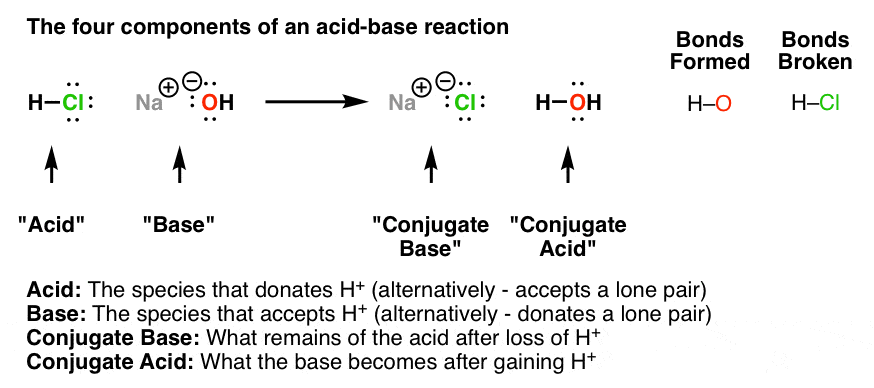
To tell a strong acid, typically see if the O outnumbers the H by two or more. Another way is if there is only one H and no oxygen in cases of the diatomic elements (BrICl).
Here's a website that goes in to further detail. chemguide
To tell a strong base, they contain -OH anions and you can find more here. chemguide
Also here's a website over acid base reactions. crashcourse
When you're tired of studying, here's a great video to cheer you up. acapellascience2
Saturday, November 21, 2015
Post 2 Chemical Reactions
We have now been learning on balancing and writing the products of the reactants which, unlike the previous method, requires two ionic aqueous compounds that switch elements in the product. You must then determine if the resultant is aqueous (spectator ions) or solid (the reactants) using the solubility rules. Here's a link that provides interesting ways to remember these rules. youtube
And here's another video to go over the equations along with other review. CrashCourse

And here's another video to go over the equations along with other review. CrashCourse
Wednesday, November 18, 2015
Post 1 Chemical Reactions
We just started a new unit beginning with the CHO method and combustion of balancing equations.
Combustion: 1. will always react with oxygen,
2. is an exothermic reaction
3. always produces CO2 and H2O
We began are unit with just balancing equations. If the prefix is represented in a decimal, the whole equation should be multiplied to equal whole numbers. Also, don't forget that, opposed to the common nomenclature rules, methane is CH4 and ammonia is NH3.
Here's a good video to start the unit off. khanacademy

Combustion: 1. will always react with oxygen,
2. is an exothermic reaction
3. always produces CO2 and H2O
We began are unit with just balancing equations. If the prefix is represented in a decimal, the whole equation should be multiplied to equal whole numbers. Also, don't forget that, opposed to the common nomenclature rules, methane is CH4 and ammonia is NH3.
Here's a good video to start the unit off. khanacademy
Subscribe to:
Posts (Atom)