Pages

Showing posts with label Chemical Bonding. Show all posts

Sunday, March 27, 2016

Post 4 Chemical Bonding

We had a fun pancake party to celebrate the last day of school before spring break!
And here's a site that reviews over the lectures of this unit.
chem1

Sunday, March 13, 2016

Post 3 Chemical Bonding

We did an easy lab that went over chemical bonds by showing us the 3d version of the compound compared to the Lewis structure. As such, it helped us draw diagrams as well as determine the shape created.
 
Here's an example of our work.

Saturday, March 12, 2016

Post 2 Chemical Bonding

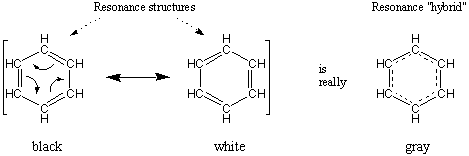
Resonance is when more than one Lewis structure can be drawn. As such, compounds must have multiple bonds and when you move the bond (double), the neighbor must be able to take the bond like in cases where H can only have one bond and thus can't double bond.
An introduction to this is shown by chemwiki.
Also know the difference in vocab as molecular shape is the molecular geometry (shape) and electronic geometry is determined by the element (lone pairs of electrons and bonds).

Here are some links from khanacademy that go over the unit up to this point.
drawing dot structures
formal charge and dot structures
resonance and dot structures


Post 1 Chemcial Bonding

Our newest lecture is over chemical bonding which involves the type of bonds as well as the shape of those elements as they bond. In covalent bonds, where bonds are shared rather than given or taken, elements can not be between a cation and an anion as this is an ionic bond, and thus this lecture doesn't apply.
First, when given a formula, make a have need share box in which:
H is the number of the element in that bond times the valence number (found in the periodic table).
N comes from the total electrons needed to be stable so you take the number of the element times 7 (where elements become stable but there are exceptions).
S determines how many bonds necessary by taking the added number of needs minus the added number of haves before dividing it by two because all bonds come in pairs of electrons.

The exceptions are:
H, He, Be = 2e-, B = 6e-, and elements in period 3 and beyond can have expanded octets including the major ones, the non-metals S, P, Xe, and Kr.

Here's some links to get into the unit:
hyperphysics